

2026 Ontario Pre-budget submission from the Ontario Coalition for Better Child Care and the Association of Early Childhood Educators Ontario.
The Ontario Coalition for Better Child Care (OCBCC) is Ontario’s central advocacy body for a universal, affordable early learning and child care system. We represent over 400 early learning and child care programs, child care associations, social justice and labour organizations, as well as concerned individuals.
The Association of Early Childhood Educators Ontario (AECEO) is the professional association for registered early childhood educators (RECEs) in Ontario. We advocate for respect, recognition and appropriate wages and working conditions for all RECEs and a high quality, publicly funded early childhood education and child care system.
Download the pre-budget submission in PDF
Federal spending on ELCC is benefiting Ontario families and the economy, but gaps remain, and it is time for Ontario to step up its contribution
The Canada-Wide Early Learning and Child Care (CWELCC) program has been life-changing for Ontario families. Thanks to substantial new federal investment of over $13 Billion since 2022, and federal-provincial collaboration, average child care fees in Ontario have dropped sharply, providing much-needed financial relief to hundreds of thousands of Ontario families.
With Ontario’s move to $22-a-day child care in January 2025, Toronto parents are saving $1,389 a month on average on infant child care compared to 2019. In Mississauga, Richmond Hill, Brampton, and Vaughan, the 2025 savings were approximately $1,000 a month for an infant space. In most other locations in Ontario savings were well over $500 a month. However, fee reductions are now stalled and will not meet the target of an average of $10aDay in March 2026, as promised.
CWELCC has also funded wage improvements for some Registered Early Childhood Educators (RECEs), who now have a wage floor of $25.86. While this modest improvement was direly needed, it falls far short of making child care wages competitive, fails to comply with the Pay Equity Act, and is well behind other provinces and territories that have introduced wage grids,
benefits, and pension plans.
There has also been modest expansion of spaces thanks to CWELCC, although access still falls far short of meeting demand in Ontario. The Auditor General of Ontario has reported that only 75% of promised child care spaces have been created.
Despite these challenges, and although the program is still in its infancy, the CWELCC program has already led to important economic benefits across Canada. A 2024 economic analysis found:
- New jobs in the ELCC sector make it the sixth-largest source of new employment in Canada since CWELCC started.
- Female labour supply has increased in line with expanded ELCC services, through two channels: improved labour force participation, and more full-time work. Combined, this has increased female core-age (25-54) labour supply by 175,000 full-time equivalents.
- The combination of increased ELCC activity, expanded spin-off work (in upstream supply chains and downstream consumer industries), and enhanced female employment has raised Canada’s national GDP by $32 billion (or over 1%) since 2019.
- The new GDP supported directly and indirectly by expanded ELCC services prevented Canada from entering a technical recession in the second half of 2023.
These benefits are felt in Ontario, where over 300,000 Ontario families are benefiting from more affordable child care. The Ontario government also benefits from these savings to families, through job creation, female labour force participation, and families spending money in their local economies. In addition, since the introduction of CWELCC’s fee reductions, the Ontario government has been saving between $100-200 million each year on its own CARE Tax Credit spending, as parents are claiming less for child care expenses.
Yet, as federal contributions have grown, the Ontario government’s child care funding has virtually flatlined. Ontario’s child care allocations - including Local Priorities funding that supports inclusion of children with disabilities in child care - have not even been indexed to inflation, let alone increased to meet the needs of a growing sector. Ontario has not re-invested its CARE Tax Credit savings into bolstering the child care system. Although child care has historically been a provincial responsibility, research from the Canadian Centre for Policy Alternatives shows that federal contributions to ELCC started eclipsing provincial spending in 2022-23, and now stands at more than 56% federal contribution versus 44% provincial contribution.
Ontario’s CWELCC funding agreement with the federal government is set to expire in December 2026. It is important that Ontario renews this agreement. While there is certainly room for the federal government to further increase its funding, given the benefits to Ontario families - and Ontario’s economy - the Ontario government should pay its fair share, boosting its contribution to CWELCC by at least $500 million to match federal investments. If both governments commit to long-term collaboration, and full and sustained funding of the system, the Ontario child care sector could ensure that CWELCC is strengthened and expanded to:
- Reach full affordability targets;
- Solve the child care workforce shortage with decent work and pay; and
- Serve all families in a universal program.
Follow the Roadmap to Universal Child Care in Ontario
In September 2025, the OCBCC and the AECEO released the second edition of our Roadmap to Universal Child Care in Ontario. Created in consultation with our members, partners, and allies, the Roadmap sets out a hopeful vision of an early learning and child care system with affordable fees, decent work and pay for educators, and access for all, and recommends policy interventions to make that vision a reality.
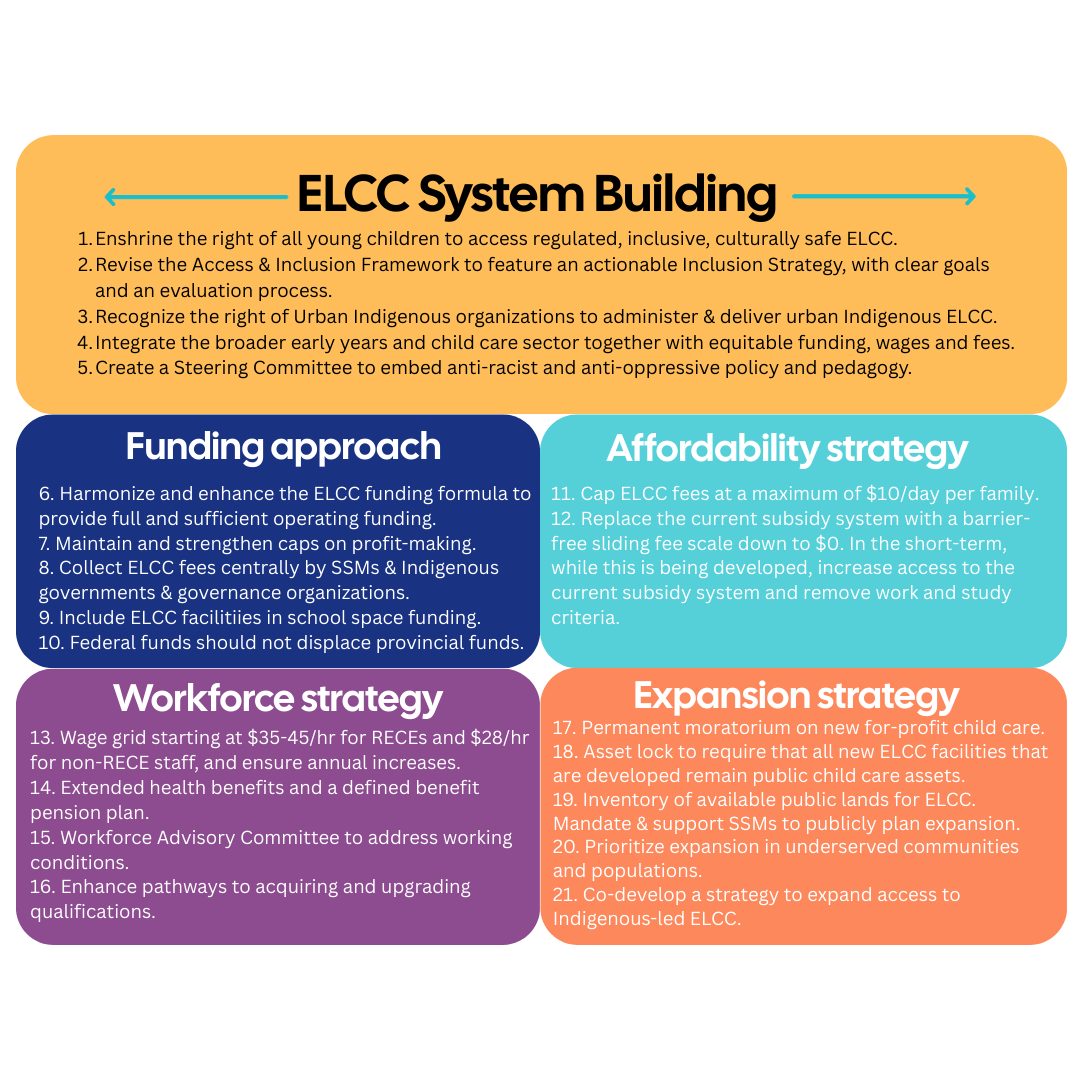
The Roadmap lays out the policy interventions that Ontario should make to address ELCC system building, funding, affordability, workforce, and expansion, and to move Ontario to a more affordable and equitable child care system. The following graphic summarizes the Roadmap’s 21 policy interventions.
The ELCC Workforce is Critical to Success
While all aspects of ELCC system building are important, it is crucial right now to understand the need for investment in the ELCC workforce, given the critical shortage of RECEs and child care workers. Many RECEs are leaving the field due to a lack of appropriate pay and working conditions. Many educators, predominantly women, are being forced to make difficult decisions about whether to continue in the field they love, or leave for a job with higher wages that includes health benefits and pension plans. The Auditor General of Ontario estimates that Ontario will be short 10,000 RECEs by the end of 2026 to meet the expansion goals of the CWELCC program. Without an attractive, competitive wage that keeps staff in their positions, we cannot hope to expand affordable child care programs in Ontario. The impact of the current shortage is that many child care centres are not at capacity because they cannot staff existing spaces. Centres have rooms closed because they cannot retain RECEs. We cannot hope to expand the program if we are not able to staff the spaces currently available. As the workforce crisis has grown, the number of RECEs working in child care has decreased from 59% in 2022to 56% in 2025. In the last five years, the number of “director approvals” or unqualified staff working in RECE positions has increased from 159 to 1,997 across the province, further demonstrating the need to address wages and working conditions, and ensure that pathways to acquiring and upgrading qualifications are made available.
This crisis will not improve without intervention and financial investment. RECEs and other child care staff need a pay equity compliant early years and child care wage grid including:
- At least $35-45 per hour for Registered Early Childhood Educators (RECE);
- At least $28 for non-RECE staff;
- Pension and benefits plans.
Supporting all parts of the ELCC sector
The OCBCC and the AECEO supports the Ontario Federation of Indigenous Friendship Centres’ (OFIFC) pre-budget recommendation on ELCC, calling for $1.3 million annually administered through the OFIFC, to implement the OFIFC’s approach to the delivery of Indigenous Early Learning and Child Care through Friendship Centres. This will help meet the demand for at least 13,000 child care spaces within urban Indigenous communities.
The workforce crisis in early years and child care is not limited to CWELCC. RECEs working in EarlyONs, Authorized Recreation, and other settings, as well as RECE Special Needs Resource Consultants, have been left behind in the creation of the wage floor for RECEs in CWELCC. Just as, during in the implementation of Full-Day Kindergarten, RECEs left child care to work for employment in school boards, where jobs are unionized and typically include health benefits, now RECEs in EarlyONs are leaving family support for the higher wages available in CWELCC-funded child care. Ontario must ensure wage parity across the broader early years and child care sector for work of equal value, with equal requirements, and registration with the College of ECE.
In summary, Ontario must work collaboratively with the Federal government to strengthen and expand the Canada-Wide Early Learning and Child Care system, and Ontario must invest to ensure that the broader early years and child care system - from EarlyONs to school-age child care - can support all Ontario families. It’s time to value and fund early learning and child care for all.
For more information contact:
Carolyn Ferns | OCBCC Policy Coordinator | [email protected]
Amber Straker | AECEO Executive Director | [email protected]